Sunday, September 17, 2017

Book: Hamburger Gourmet
Ok, so I have to be honest, this one is kinda half in here based on aesthetics. Its another lovely looking book, with great images. Its entirely about burgers, and is from the chefs from a Parisien burger joint called Blend, and is what it sounds - a recipe book of burgers.


As has become trendy over the last decade or so, it features a range of more adventurous burgers, with different meats, avocados, etc. It dedicates a couple pages to equipment, to the different components (cheese, buns, sauces) but the bulk is just the burger recipes. I have read it, several times, although honestly not followed any of the recipes (I'm more of a smashed beef, salt, pepper kinda burger guy), but its fun to read none the less (and I have kept it).


It's hard to really see that it offers much more beyond what you'd find on the internet, but if you know someone who is really into their burgers (making their own beef blends at home, which honestly, I have been more than a bit tempted to do) then this would be a nice gift.

Friday, January 20, 2017

Book: Franklin Barbecue
Lets get one thing straight, first of all. Whenever I talk about BBQ on here, its almost certainly going to be referring to the low'n'slow style that is more commonplace across the US, as opposed to the hot'n'fast sausages and burgers that we are more used to over here in the UK.

I am a big fan of BBQ, have grown up on summers full of hot'n'fast (not just burgers and sausages though - fish, pork chops, lamb cutlets etc) and have since got into smoking food, that is the US, low'n'slow, pitmaster BBQ approach of cooking large, relatively tough cuts of meat for long periods of time (hours). For this, I own a Weber Smokey Mountain, which is a large smoker that is capable of easily holding a decent low temperature for hours, and have cooked a range of things (pork ribs, beef short ribs, pork shoulder etc).

To be honest though, BBQ books are a bit of a strange one. I own several BBQ books (including Aaron Franklin's book), and regularly pick them up and peruse them, but the thing is, there isn't that much to it, and whats more, lots of the books will give you quite different, often contrasting advice. Really, when it comes to low'n'slow BBQ, its not so much about recipes, its about technique, experience and patience - stuff that a book can't really teach you. Most BBQ recipes you might see, let's say for beef brisket, will follow something along the lines of: trim the fat off the meat, salt + season the beef with a preferred dry-rub (this is where there maybe some variation, everyone will have their own special dry-rub ratio, but it will likely be some variation of each other), cook for some hours (they might recommend anything between 10 and 18 hours). They might also recommend wrapping it mid way through, but really thats all there is to it. And given the contrasting advice, and the differences in BBQs, pieces of meat, etc,  I have concluded it comes down to experience. Cook a piece a few times and you will get to recognise the feel, look and temperatures that work for you.

But that said, I still enjoy reading my BBQ books - both for inspiration, aesthetics and to get into the mood to BBQ!


This book, specifically, has some nice history and Aaron talks about how he first got setup by cooking for the neighbourhood, and challenges the restaurant has faced (it got burnt down), along with some recipes and techniques. Not my favourite BBQ books, but there is no denying he knows his stuff - and he comes across nicely, so its a nice addition for a BBQ fan (not necessarily a good first book for someone starting out in BBQ) - if you want quicker insight into the how-to of BBQ, Aaron has published lots of videos on his Youtube channel of him actually cooking stuff, which are worth a look.

Tuesday, November 1, 2016

BBQ: Barbeskew
For my 30th birthday, as a surprise gift (having witnessed me spending all my time in garden centres playing with the display models), my wife bought me a BarbeSkew - I believe the product was originally launched on Dragons Den (don't quote me on that), and its USP is that it has a rotisserie function (3 main spits across the top, supporting both a normal spit and several cage spits).


If hot-n-fast is your thing (or relatively fast at least - I regularly cook whole chickens or joints of meat that cook for a couple of hours), then this is a great addition to your outside eating setup. It has a normal grill and can easily operate as a regular BBQ for grilling, but because of the rotisserie, it doesn't have a sealable lid, so can't really be setup for indirect cooking (if you wanted to start experimenting with low-n-slow, for example, this wouldn't be so good). I use this along side my Weber Smokey Mountain - cooking whole chickens (or any chicken really) this is still my preferred option - and cooking for a crowd, you can easily setup the two cages with sausages/burgers/chicken and leave it to cook not having to worry about it burning or turning it.


Honestly, there is something special about rotisserie chicken over hot coal - succulent, moist with beautifully crisp skin, perfectly seared over the high temperatures and direct heat of the coals.

Wednesday, October 19, 2016

Book: The Foodlab
By some way, my favourite food-science author, chef and general internet personality, Kenji Lopez-Alt, has written what is going to be the first in a series (of at least two, lets hope more!) books The Foodlab (his online moniker writing as himself and on the popular SeriousEats site).


The introduction, although it goes much further, and longer, than a regular introduction, covers a range of topics - heat exchange in cooking, the importance of saucepan material, the importance of experimentation and control - the list goes on, and its a fascinating read. As a nerd/foodie/hobbyist cook this book is one of my favourites to read, you can pick it up and flick to pretty much anywhere and you will find an engrossing long-form discussion on some dish or technique.

It's not all theory, of course, but what makes the book great, is before each recipe, or category of recipes, Kenji breaks down the components, why they are important and how he ended up on the recipe. Take his chilli-con-carne recipe, for example - preceding that, there are several pages of detailed discussion of the why and the how of the recipe, along with explanation as to his journey to get there (how long should you soak the beans? can you use any variety of chillis? what mean should you use? how can I make it more meaty?). That is just one example - but nothing is left un-answered, is there a quicker way to cook risotto? (do I need to keep stirring it? can I add all the liquid up front rather than bit-by-bit), when should I salt the meat for my burgers?

The reason this is all so useful, is not just that it makes for an interesting read whilst lounging on a Sunday morning, but in understanding the building blocks, which parts are important and which parts aren't, where you can make substitutions, then it helps you understand your cooking, other meals you might make or other recipes you might come to interpret. You may find yourself reading other recipes and thinking I don't have that ingredient, but it doesn't batter because I can change it for X, or I don't really need to do that part.


Even if you don't get the book, following him online (his writing on SeriousEats, twitter, instagram, his youtube videos) you will become a better home cook.

Monday, June 13, 2016

Book: Ruhlman's Twenty
Probably my second favourite of my food-books, at least those to just pick up and read.


Let's get this out the way first of all, its a beautiful book. The typography, the colours, the blocks (its almost like it anticipated the flat-design trend that we have seen the last few years). Visually, all the little touches are a delight.

But that's not the only reason I enjoy it. It's another book that nicely combines readable and accessible food science theory along side recipes (like The Foodlab). The book is broken down into 20 different techniques (maybe thats a bit of a stretch - its broken down into techniques and large/core ingredient groups) - covering water, salt, onions, acid, butter etc - a bit like an extended run on Salt, Fat, Acid, Heat (the book, more recently made famous through its Netflix series - it covers these, in specific forms, but also covers other core areas).

Each section starts with an overview of the area, and ends with a handful of recipes. Easily readable and just simple things will stay with you and improve your cooking (the stage at which you salt & his tomato experiment - the implications of over-bubbling/spilling a liquid when you are supposed to be reducing it etc)


Saturday, March 12, 2016

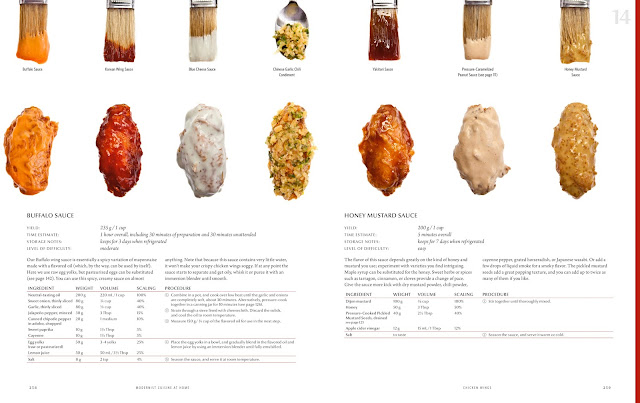
Book: Modernist Cuisine at Home

I love cooking. I try to do it whenever I get the chance (which, between kids and work, is mostly just the weekends).

I'm also a programmer, so I like logic, science and generally understanding what is happening under the hood, and that applies to food - If you know what is going on when you cook, then you can change things without ruining your food!


And thankfully, over the years this concept, that of food-science for hobby-ist nerds, has become quite a big thing. And that's what this book is all about - food science. There is a bigger set of books, but at approaching £400 I consider the price prohibitive.  This one can still set you back around £80, but its a decent size and if you are interested in science its worth a look (although, honestly, the Foodlab book probably takes my number one spot, if you were looking to buy just one book).